How Much Water Does the Average Household Use in Canada?

· 11 min read
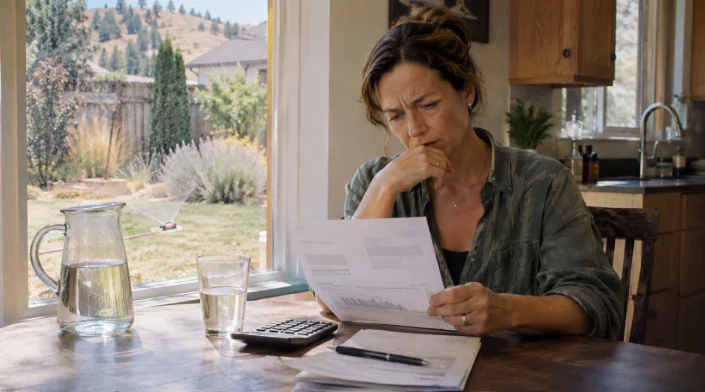
A water bill showing 25 or 40 cubic metres of consumption can be difficult to interpret, especially if you have recently moved, welcomed another family member or started watering a larger garden. Is that amount typical, or are you using considerably more water than other households?
According to Statistics Canada, average residential water use in Canada was 205 litres per person per day in 2024. That figure provides a useful starting point, but household size, seasonal irrigation, plumbing efficiency and local climate can make a considerable difference, particularly in British Columbia’s Okanagan Valley.
How Much Water Does the Average Canadian Use Each Day?#
Statistics Canada’s Survey of Drinking Water Plants, released on September 28, 2026, provides updated national and provincial figures for potable water consumption in 2024.
Average daily residential water consumption has generally declined over the past decade.
| Year | Residential water use per person per day |
|---|---|
| 2011 | 251 L |
| 2013 | 222 L |
| 2015 | 234 L |
| 2017 | 221 L |
| 2019 | 216 L |
| 2021 | 223 L |
| 2024 | 205 L |
Source: Statistics Canada, Table 38-10-0271-01, Potable Water Use by Sector and Average Daily Use.
The 2024 figure represents a reduction of approximately 18% compared with 2011. More efficient plumbing fixtures, improved appliances and water conservation measures are among the factors that can contribute to lower residential consumption.
However, 205 litres is a statistical average rather than a recommended daily allowance. It includes residential activities such as bathing, flushing toilets, washing clothes, preparing food and watering gardens with water supplied by the systems covered by the survey.
The survey does not capture every private well or small independent water system, so the figure should be treated as a broad residential benchmark rather than an exact measurement of every Canadian household.
Residential Water Use Versus Total Water Use#
Some publications report Canadian water consumption at close to 400 litres per person per day. That does not necessarily contradict the lower household figure.
Residential water use refers to water consumed by households, while total potable water use also includes water supplied to businesses, industries, institutions and other users, as well as losses within distribution systems.
A restaurant washing dishes, a hospital operating its facilities and a household watering its garden all contribute to demand on public water systems, but only the household’s consumption belongs in the residential category.
If you are comparing your family’s water bill with a national benchmark, residential water use is the more relevant measurement.
Why Provincial Averages Differ#
Residential water consumption varies considerably across Canada. Housing density, precipitation, outdoor watering, plumbing infrastructure and utility billing arrangements can all influence how much water households use.
British Columbia illustrates why provincial averages only tell part of the story. A household on the rainy coast faces very different landscaping demands from a detached home in the dry southern Interior.
Even neighbouring communities can have different consumption patterns depending on property sizes, irrigation practices and water metering. A national average is useful for comparison, but local conditions often explain why a particular household falls above or below it.
What Does Normal Water Use Look Like for Different Household Sizes?#
Using the national average of 205 litres per person per day, it is possible to estimate a reasonable starting point for households of different sizes.
| Household size | Estimated daily use | Estimated monthly use (30 days) |
|---|---|---|
| 1 person | 205 L | 6.15 m³ |
| 2 people | 410 L | 12.30 m³ |
| 3 people | 615 L | 18.45 m³ |
| 4 people | 820 L | 24.60 m³ |
| 5 people | 1,025 L | 30.75 m³ |
A family of four using around 25 cubic metres of water over a 30-day billing period is therefore close to the national per-person average.
These figures are calculated benchmarks, not measured averages for each household size. Actual consumption does not always increase in direct proportion to the number of occupants.
Two people living together can share dishwasher loads, laundry and garden maintenance. Meanwhile, someone living alone may use just as much water to maintain a lawn as a family occupying a similar property.
A small apartment occupied by four people could consequently use less water than a detached home occupied by two people with an extensive irrigation system.
For a meaningful comparison, consider the number of residents alongside the type of property, its outdoor space and the time of year.
Where Does Household Water Actually Go?#
Most residential water consumption comes from a handful of recurring activities. Understanding how those activities affect your meter readings makes it easier to identify meaningful savings.
Toilets, Showers and Bathroom Fixtures#
Bathrooms account for a significant share of indoor water consumption because toilets, showers and taps are used repeatedly throughout the day.
Consider a showerhead delivering nine litres per minute. An eight-minute shower uses approximately 72 litres, while a five-minute shower uses 45 litres. That difference of 27 litres adds up to 810 litres over a month if the shower is taken daily.
Toilets can also contribute significantly to consumption. An older, inefficient toilet may require considerably more water per flush than a modern low-flow model.
Hidden toilet leaks deserve particular attention because they can waste water continuously without leaving a visible puddle or producing an obvious sound. A small leak that goes unnoticed for several weeks can easily offset the savings achieved through shorter showers and more efficient appliances.
Laundry, Dishwashing and Kitchen Use#
Laundry consumption depends on the washing machine’s efficiency, selected cycle and number of loads. Households with young children, active teenagers or several adults may naturally wash clothes more frequently.
Dishwashers and kitchen taps also contribute to daily consumption, although the amount depends heavily on individual habits and appliance efficiency.
When assessing water use, consider how much water is needed to complete a task rather than simply counting how often an appliance runs. Combining smaller laundry loads, avoiding unnecessary pre-rinsing and selecting appropriate washing cycles can reduce consumption without requiring major lifestyle changes.
Lawns, Gardens and Other Outdoor Uses#
Outdoor watering can quickly exceed the amount of water used indoors.
For every millimetre of water applied to one square metre of lawn, one litre is required. Applying 20 millimetres of water to a 150-square-metre lawn therefore requires 3,000 litres, or three cubic metres.
That single watering amount is equivalent to nearly five days of average residential consumption for a three-person household.
The calculation helps explain why summer water bills can increase substantially even when indoor habits remain unchanged.
Why Water Consumption Is Higher in the Okanagan#
The Okanagan’s semi-arid climate creates conditions quite different from those in many other parts of Canada. Hot summers, relatively limited precipitation and an extended growing season increase demand for landscape irrigation.
An update to the Okanagan Water Supply and Demand Study, conducted between 2015 and 2018, found that the average household in the region used 1,032 litres of water per day, calculated across the entire year.
According to the Okanagan Basin Water Board, consumption was divided approximately as follows:
- Indoor water use: 391 litres per household per day (38%).
- Outdoor water use: 641 litres per household per day (62%).
These are historical, annualized household averages. The outdoor figure reflects water use concentrated primarily during the warmer months rather than an amount consumed consistently throughout the year.
The research also identified geographic differences. Residents in the North Okanagan generally experience greater precipitation and lower water demand than those in the drier South Okanagan. In the Central Okanagan, including Kelowna, consumption varies considerably depending on property characteristics, landscaping and irrigation practices.
What Seasonal Consumption Can Look Like in Kelowna#
Imagine a three-person household with a 150-square-metre lawn and baseline indoor consumption of 450 litres per day.
During a 30-day winter billing period, the household uses approximately 13.5 cubic metres of water.
During summer, applying an illustrative 20 millimetres of irrigation water per week to the lawn adds 3,000 litres each week. Over 30 days, that amounts to approximately 12.9 additional cubic metres.
The household’s monthly consumption would consequently increase from 13.5 to approximately 26.4 cubic metres without any changes to its indoor routines.
This example is not a recommended watering schedule. Actual irrigation requirements depend on weather, soil conditions, plant needs and the restrictions established by your water provider.
It does, however, demonstrate why comparing a July water bill with a January bill can give a misleading impression of household efficiency.
How to Calculate Your Own Daily Water Consumption#
The most reliable way to assess your household’s consumption is to calculate it using actual water meter readings or utility billing records.
Finding the Consumption Figure on Your Water Bill#
Start by locating the volume of water used during the billing period. This will generally be expressed in cubic metres (m³).
Avoid using the dollar amount alone to estimate consumption. Depending on your provider, a utility bill may contain fixed service charges, consumption-based charges, wastewater fees and other costs.
A higher bill does not automatically mean you have used more water.
You should also check the number of days covered by the bill. Some utilities use billing periods longer than one month, and comparing two bills without accounting for their duration can distort the results.
If you live in a condo or rental property without an individual water meter, building-level consumption figures may not provide an accurate picture of your household’s personal water use.
Converting Cubic Metres Into Litres#
One cubic metre contains 1,000 litres.
To calculate your average daily water consumption per person, use the following formula:
Litres per person per day = (Water use in m³ × 1,000) ÷ (Billing days × Number of residents)
For example, suppose a three-person household receives a water bill showing 24 cubic metres of consumption over 30 days.
The calculation is:
24 × 1,000 ÷ 30 ÷ 3 = 267 litres per person per day
That household is using approximately 30% more water per person than the 2024 national residential average.
The next step is to determine whether the difference comes from outdoor watering, inefficient fixtures, additional household activities or an unidentified leak.
For Kelowna residents served by the City Water Utility, compatible upgraded water meters can also be connected to EyeOnWater, which provides detailed consumption information and leak alerts. This makes it easier to identify usage patterns between billing periods rather than waiting for the next water bill.
When Is Your Household Using Too Much Water?#
There is no single consumption threshold that identifies excessive water use in every household. Exceeding the national average is a reason to examine your consumption, not necessarily evidence that something is wrong.
The pattern of water use is often more revealing than the total amount.
Higher consumption during July and August may have a straightforward explanation if you maintain a garden. An unexplained increase in February, when the irrigation system is switched off, deserves closer investigation.
Pay particular attention if:
- Water consumption increases substantially without a change in household size or routines.
- Your meter continues recording consumption when all water-using fixtures and appliances are switched off.
- Summer consumption remains unusually high even after reducing irrigation.
- Water use continues overnight when no appliances or irrigation systems are scheduled to operate.
- Toilets refill unexpectedly or unexplained wet patches appear in the yard.
A useful starting point is to establish your household’s winter consumption as an approximate indoor baseline, provided occupancy and daily routines remain reasonably consistent. You can then compare warmer months against that baseline to estimate the additional demand associated with outdoor activities.
Comparing the same month across consecutive years can also help distinguish seasonal changes from emerging plumbing problems, although differences in rainfall and temperature should be taken into account.
What to Do If Your Water Use Is Above Average#
Begin with the largest potential sources of waste rather than attempting to change every household habit at once.
If you live in an apartment or condo, focus on toilet leaks, shower duration, appliance efficiency and unnecessary tap use. If your property has a lawn and an automatic irrigation system, examine your watering schedule, sprinkler output and potential outdoor leaks before investing in new indoor fixtures.
A household that already has efficient toilets and showerheads may achieve relatively little by replacing them again. Adjusting an excessive irrigation schedule or repairing a continuous leak could deliver considerably greater savings.
The City of Kelowna’s Water Smart program provides local conservation resources and information about water-efficient landscaping and irrigation. Residents served by other providers should check which services and programmes are available through their own utility.
Once you know where your household uses the most water, you can focus on practical ways to reduce household water use without making unnecessary changes to your daily routine.
The most useful benchmark is ultimately your own household’s consumption under comparable conditions. Record your current meter reading, identify one or two areas where water could be saved and measure the difference over the following billing period.
In a region such as the Okanagan, where summer irrigation places considerable pressure on shared water resources, understanding your household’s consumption is the first step towards making every litre count.