Why Is My Water Bill So High? How to Find Hidden Water Leaks at Home

· 11 min read
An unexpectedly high water bill is frustrating, particularly when nobody in your household has changed their daily routine. There may be no dripping taps, no visible water damage and no obvious explanation for the extra consumption.
Hidden toilet leaks, underground irrigation problems and appliances that use water automatically can all increase your bill without attracting much attention. Before assuming you have a plumbing problem, however, it is worth checking whether your actual water consumption has increased or whether changes to your utility charges are responsible.
Is Your Water Use Higher, or Has Your Bill Simply Increased?#
A higher water bill does not necessarily mean your household is using more water. Utility rates, billing periods and additional service charges can affect the amount you pay independently of consumption.
Compare Consumption Before Comparing Dollar Amounts#
Locate the water consumption figure on your current and previous utility bills. For most metered households, this is expressed in cubic metres (m³), with one cubic metre representing 1,000 litres.
Depending on your water provider, your bill may include several components:
- Fixed water service charges.
- Consumption-based water charges.
- Wastewater or sewer service fees.
- Infrastructure or water quality improvement charges.
- Outstanding balances or billing adjustments.
Some utilities also use tiered water rates, meaning the price per cubic metre increases once consumption reaches a particular threshold.
If your consumption has remained relatively stable but your bill has increased, investigate changes to these charges before searching for leaks.
Account for Summer Watering and Longer Billing Periods#
Comparing bills covering different numbers of days can create a misleading impression of increased consumption.
For example, a household using 18 m³ over 30 days consumes an average of 600 litres per day. If its next bill shows 36 m³ over 60 days, daily consumption has not changed at all.
Seasonal differences are particularly relevant in Kelowna and the wider Okanagan. Lawn watering, garden irrigation, pool maintenance and outdoor cleaning can add considerably to summer consumption.
A better comparison is between the same months in consecutive years, allowing for differences in weather, household occupancy and watering habits.
If your water use has increased significantly without a reasonable explanation, the water meter is the next place to look.
Start With a Simple Water Meter Test#
Your water meter can help determine whether water is flowing somewhere on your property when nothing should be using it. This test requires no specialised equipment and can often narrow down the problem before you contact a plumber.
Turn Off Everything That Uses Water#
Choose a period when everyone in the household can avoid using water for at least 30 to 60 minutes.
Make sure taps and showers are closed, toilets have finished refilling, and washing machines and dishwashers are not running. Pause scheduled irrigation and check whether any automatic equipment, such as a water softener or ice maker, could operate during the test.
Locate your water meter. Depending on the property and utility, it may be installed in a basement, utility room, crawl space or accessible outdoor meter enclosure.
Record the reading or take a photograph so you can compare it later. If the meter is difficult or unsafe to access, ask your water provider for assistance rather than attempting to open a restricted enclosure.
Check Whether the Meter Is Still Moving#
Many mechanical water meters have a small flow indicator that moves whenever water passes through the meter. Digital models may display an instantaneous flow reading or a symbol indicating water movement.
If the indicator continues moving after all known water use has stopped, water is flowing somewhere beyond the meter.
Compare the meter reading again after 30 to 60 minutes. A measurable increase suggests an unidentified source of consumption.
For smaller or intermittent leaks, a longer monitoring period may be necessary. An overnight test can be useful, provided nobody uses water and automatic appliances do not operate during that time.
A stationary meter does not completely rule out a leak. Some problems only occur when toilets refill, irrigation zones activate or particular appliances are operating.
What If You Have a Digital Water Meter?#
City of Kelowna Water Utility customers with compatible upgraded meters can use EyeOnWater to monitor consumption and receive notifications about potential leaks.
The service helps identify patterns that would otherwise be difficult to detect through ordinary utility bills. Continuous overnight consumption, for example, may indicate a leaking toilet or irrigation problem.
The City recommends a moderate leak-alert threshold of four litres per hour as a starting point. More sensitive settings are available for smaller flows.
An alert is not a diagnosis. It tells you that water is being used continuously, but you still need to determine where that water is going.
Residents served by other Kelowna water providers should check whether their utility offers similar monitoring services.
The Most Common Sources of Hidden Water Leaks#
Different types of leaks produce different consumption patterns. Knowing what to look for can save considerable time during an investigation.
| What you notice | Possible cause | What to check first |
|---|---|---|
| Continuous low water flow | Leaking toilet or tap | Toilet tanks and plumbing fixtures |
| Water use increases overnight | Scheduled equipment or a continuous leak | Irrigation controller and appliances |
| Unusually wet patch in the yard | Underground irrigation or service-line leak | Buried pipes and sprinkler valves |
| Higher summer consumption | Excessive watering or damaged sprinklers | Irrigation schedules and sprinkler heads |
| Higher winter consumption | Indoor plumbing or appliance problem | Toilets, water softener and accessible pipes |
| Higher bill with unchanged consumption | Rate increase or billing adjustment | Utility charges and billing period |
Toilets That Leak Without Making Noise#
A leaking toilet is particularly easy to overlook because the water usually flows directly from the tank into the bowl and down the drain. There may be no water on the bathroom floor and very little sound.
A simple food colouring test can reveal this type of leak.
- Remove the toilet tank lid.
- Add several drops of food colouring to the tank.
- Wait 15 minutes without flushing.
- Check whether coloured water has appeared in the toilet bowl.
- Flush afterwards to remove the colouring.
If colour appears in the bowl, water is escaping from the tank.
The cause may be a worn flapper, a damaged flush valve seal or a fill valve that allows water to enter the overflow tube.
Check every toilet in the house, including those in guest bathrooms or rarely used basement areas. A toilet that occasionally refills on its own is another reason to investigate.
Irrigation Leaks You Cannot Easily See#
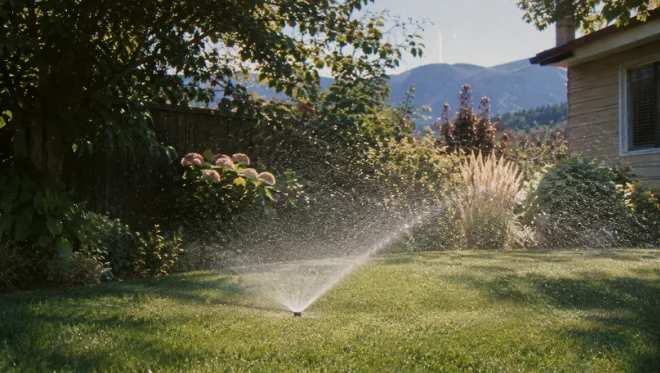
Automatic irrigation systems can waste substantial amounts of water because much of their infrastructure is buried underground.
In the Okanagan, irrigation problems may become apparent when systems are restarted in spring. Freezing conditions, ageing components and movement in the soil can damage pipes, connections and sprinkler heads.
Look for persistently damp areas, unusually green patches of grass, pooling water, reduced sprinkler pressure or sprinkler heads that continue leaking after a watering cycle has ended.
A faulty irrigation valve can allow water to flow even when the controller is switched off. Turning off the controller therefore does not necessarily stop an underground leak.
If your irrigation system has a separate, accessible shut-off valve, closing it temporarily and repeating the meter test may help identify whether the problem lies within the outdoor system. Avoid forcing a seized valve or interfering with backflow prevention equipment.
When the meter stops recording unexplained consumption after the irrigation supply is isolated, the outdoor system deserves further investigation.
Outdoor Taps, Appliances and Service Lines#
Outdoor hose connections can develop leaks after exposure to freezing temperatures. Some damage only becomes apparent when the tap is opened for the first time in spring.
Inside the home, check accessible plumbing connections beneath sinks, around washing machines and behind toilets. Water softeners, reverse osmosis systems and other equipment with drain connections can also consume water unexpectedly if a component malfunctions.
Inspect the area around your hot water tank for unusual moisture or continuous discharge. Never plug or disable a pressure-relief valve; persistent discharge requires professional attention.
Underground water service lines present a different challenge. Possible warning signs include persistent wet ground, unexplained water movement through the meter or water appearing near the foundation.
Whether a service-line leak affects your meter reading depends on the leak’s location relative to the meter.
How Much Water Can a Small Leak Waste?#
A leak does not need to produce a noticeable stream of water to affect household consumption. Even a slow, continuous flow becomes significant when it continues throughout the day and night.
Consider a leak wasting four litres per hour.
Over 24 hours, it loses 96 litres. Over a 30-day billing period, that becomes 2,880 litres, or 2.88 cubic metres.
The following examples illustrate how continuous leaks accumulate over time.
| Leak rate | Daily water loss | Monthly water loss (30 days) | Annual water loss |
|---|---|---|---|
| 1 L/hour | 24 L | 0.72 m³ | 8.76 m³ |
| 4 L/hour | 96 L | 2.88 m³ | 35.04 m³ |
| 10 L/hour | 240 L | 7.20 m³ | 87.60 m³ |
| 20 L/hour | 480 L | 14.40 m³ | 175.20 m³ |
| 30 L/hour | 720 L | 21.60 m³ | 262.80 m³ |
A continuous leak of 20 litres per hour would waste more than 175,000 litres over an entire year.
Calculate the Cost of Your Water Leak#
You can estimate additional consumption charges using your water provider’s applicable rate.
Water wasted (m³) = Leak rate (L/hour) × 24 × Billing days ÷ 1,000
Additional water charge = Water wasted (m³) × Applicable rate per m³
For example, using an illustrative consumption rate of C$2 per cubic metre, a four-litre-per-hour leak would add approximately C$5.76 to a 30-day water bill.
A 30-litre-per-hour leak would add approximately C$43.20 over the same period, or C$525.60 over a full year.
These are illustrative calculations, not current Kelowna utility rates. Actual costs depend on your water provider, applicable consumption tiers and whether additional wastewater charges are linked to water consumption.
The financial cost is only part of the problem. An underground or concealed plumbing leak can also damage landscaping, foundations and building materials.
When to Contact Your Water Provider or a Plumber#
Contact a plumber when you suspect a problem within your home’s plumbing, including concealed pipe leaks, persistent toilet problems or malfunctioning water-connected appliances. An irrigation contractor may be more appropriate when the evidence points to a buried sprinkler system.
If water is actively flooding your home, close the household’s main water shut-off valve if it is safe to do so and seek professional assistance immediately. Avoid standing water near electrical equipment.
Contact your water provider when you suspect a public water main break, need assistance with the meter, require a shut-off at the property boundary or cannot establish where responsibility for a service-line repair begins.
Kelowna has several independent water providers, so responsibility for particular sections of the water service and procedures for repairs may differ. Check with the utility serving your address before arranging underground work.
Can Your Water Bill Be Adjusted After a Leak?#
The City of Kelowna accepts consumption review requests following confirmed leaks. Depending on the circumstances, affected consumption may qualify for an adjustment to a lower billing tier.
An adjustment is not automatic, and property owners generally remain responsible for water consumed on their property.
If you discover and repair a leak, retain photographs, contractor invoices and receipts for replacement materials. Record subsequent meter readings to demonstrate that consumption has returned to its usual level.
Contact your utility billing office for eligibility requirements, documentation instructions and payment arrangements while the request is being reviewed.
Other water providers and municipalities may have different policies.
Preventing Another Unexpected Water Bill#
Regular monitoring is considerably easier than investigating several months of unexplained consumption.
Check your water meter periodically, test toilet tanks for silent leaks and inspect visible plumbing connections. If your property has an automatic irrigation system, examine it when restarting it in spring and watch for changes in consumption throughout summer.
Where digital monitoring is available, enable leak notifications rather than relying exclusively on utility bills. A small problem discovered within a few days is generally easier to manage than one that continues unnoticed for an entire billing cycle.
It also helps to establish separate winter and summer consumption benchmarks for your property. A sudden increase during winter may point towards an indoor plumbing issue, while an unexpected summer spike may warrant a closer look at irrigation.
Finding and fixing a leak is only the first step towards a more water-efficient home, especially in communities where summer irrigation can account for a substantial share of annual consumption.
After completing a repair, continue monitoring your meter to confirm that the unexplained flow has stopped. Your next utility bill should then reflect the improvement, rather than simply leaving you hoping that the problem has been resolved.